Презентация на тему: "Марковников Владимир Васильевич, знаменитый российский химик. На английском языке."
- Категория: Презентации / Другие презентации
- Просмотров: 45
Презентация "Марковников Владимир Васильевич, знаменитый российский химик. На английском языке." онлайн бесплатно или скачать на сайте электронных школьных учебников/презентаций school-textbook.com

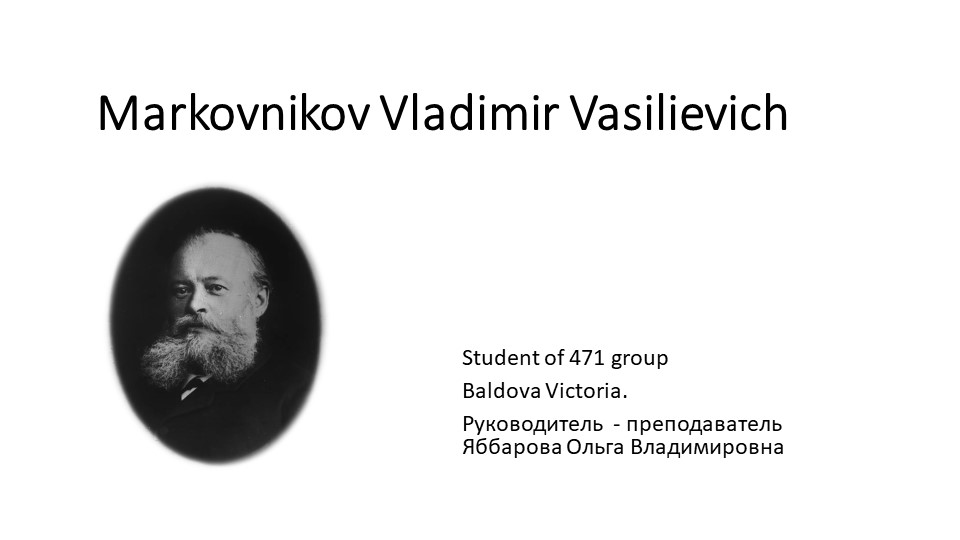
Markovnikov Vladimir Vasilievich
Student of 471 group
Baldova Victoria.
Руководитель - преподаватель Яббарова Ольга Владимировна

Markovnikov Vladimir Vasilievich
Years of life: December 13 (25), 1837 - January 29 (February 11), 1904 - Russian chemist, representative of the Kazan chemical school, founder of his own scientific school at Moscow University.
Developing the theory of the chemical structure of A. M. Butlerov, he studied the mutual influence of atoms in organic compounds and established a number of patterns (including the rule for the addition of hydrogen halides to unsaturated hydrocarbons with double and triple bonds, later named after him).
Contributed to the development of the domestic chemical industry.

Biography
Vladimir Markovnikov was born in the village of Chernorechye, Nizhny Novgorod Region. After school, in 1856 he entered the law faculty of Kazan University and at the same time attended lectures on chemistry by Professor Alexander Butlerov. After a workshop in his laboratory, he soon decided to become a chemist.
Having received a master's degree in 1865, in order to prepare for a professorship, Markovnikov went abroad for two years, where he worked in the laboratories of famous European scientists. Returning to Russia, he became an assistant professor at the Department of Chemistry at Kazan University. In 1868 he was one of the organizers of the Russian Chemical Society and one of the most active initiators of the publication of a chemical journal in Russian.

A year later, Vladimir Vasilyevich defended his doctoral dissertation and worked as a professor, first at Kazan and then Novorossiysk universities. In 1873 he received a professorship at the Department of Chemistry at Moscow University, where he set up the first large laboratory in Russia, adapted not only for practical work, but also for scientific research. The result of the laboratory's activities was more than a hundred studies carried out under the direction of Markovnikov and published in various scientific publications.
From the beginning of the 1880s, Markovnikov was engaged in the study of Caucasian oil, in which he discovered a new extensive class of compounds, which he called naphthenes, and was the first to study naphthylenes. He studied the composition of oil, laying the foundations of petrochemistry as an independent science. For great services in this field, he was awarded a gold medal at the Paris Petroleum Congress.
The main scientific works of Markovnikov are devoted to the development of the theory of chemical structure, organic synthesis and petrochemistry. His theoretical research and experimental material played a huge role in the development of chemistry and confirmed the correctness of Alexander Butlerov's theory. He discovered the isomerism of fatty acids, formulated the rules that are now known as Markovnikov's rules. He was awarded a gold medal at the Paris Petroleum Congress.

Discoveries and achievements
1869 - Formulated a rule about the direction of the reaction of addition, elimination and substitution on a double bond, as well as isomerization, depending on the chemical structure of a substance, which is now known as the Markovnikov rule.
1879 - Together with G. A. Krestovnikov, he was the first to synthesize cyclobutane dicarboxylic acid.
1883 - Discovered a new class of organic compounds - naphthenes.
Cycloalkanes (naphthenes) are cyclic saturated hydrocarbons that form a homologous series with the general formula CnH2n.
1889 - First received suberon.
Cycloheptanone (Suberon) is a colorless liquid with a minty odor, a member of the class of cyclic ketones.
Ketones are organic compounds in which the carbonyl group is bonded to two hydrocarbon radicals.
1892 - Discovered the first isomerization of cyclic hydrocarbons with cycle reduction.

Markovnikov's rule
In addition reactions, hydrogen is added to a more hydrogenated carbon atom, that is, an atom that has more hydrogen atoms.
The rule was formulated by V.V. Markovnikov in 1869.

Exceptions to the Markovnikov rule
The addition of electrophilic and nucleophilic agents to compounds with conjugated bonds containing an electronegative group at the carbon atom of the double bond occurs against the Markovnikov rule in accordance with the shift in electron density to the most electronegative atoms, for example:

Joining against Markovnikov's rule: